


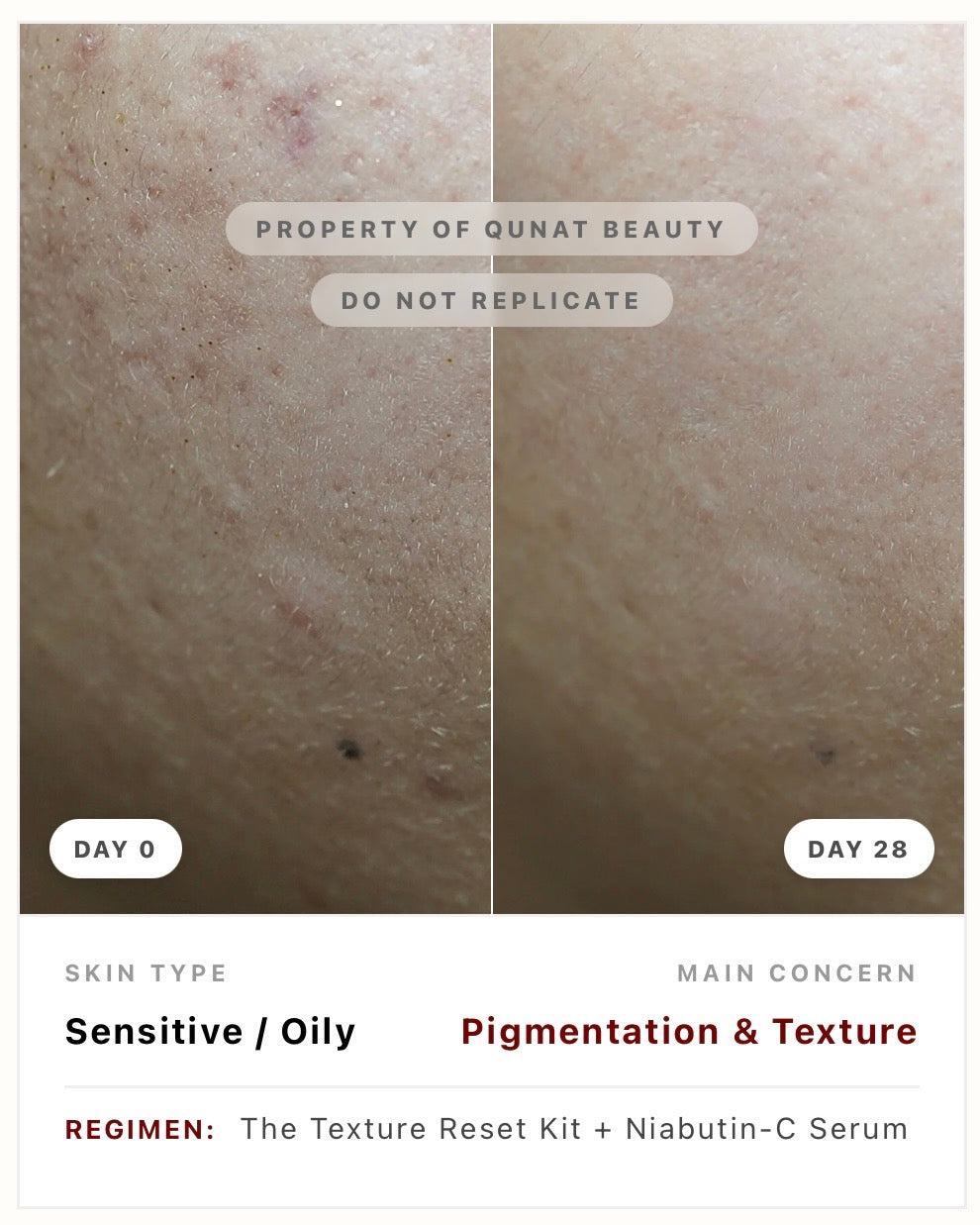


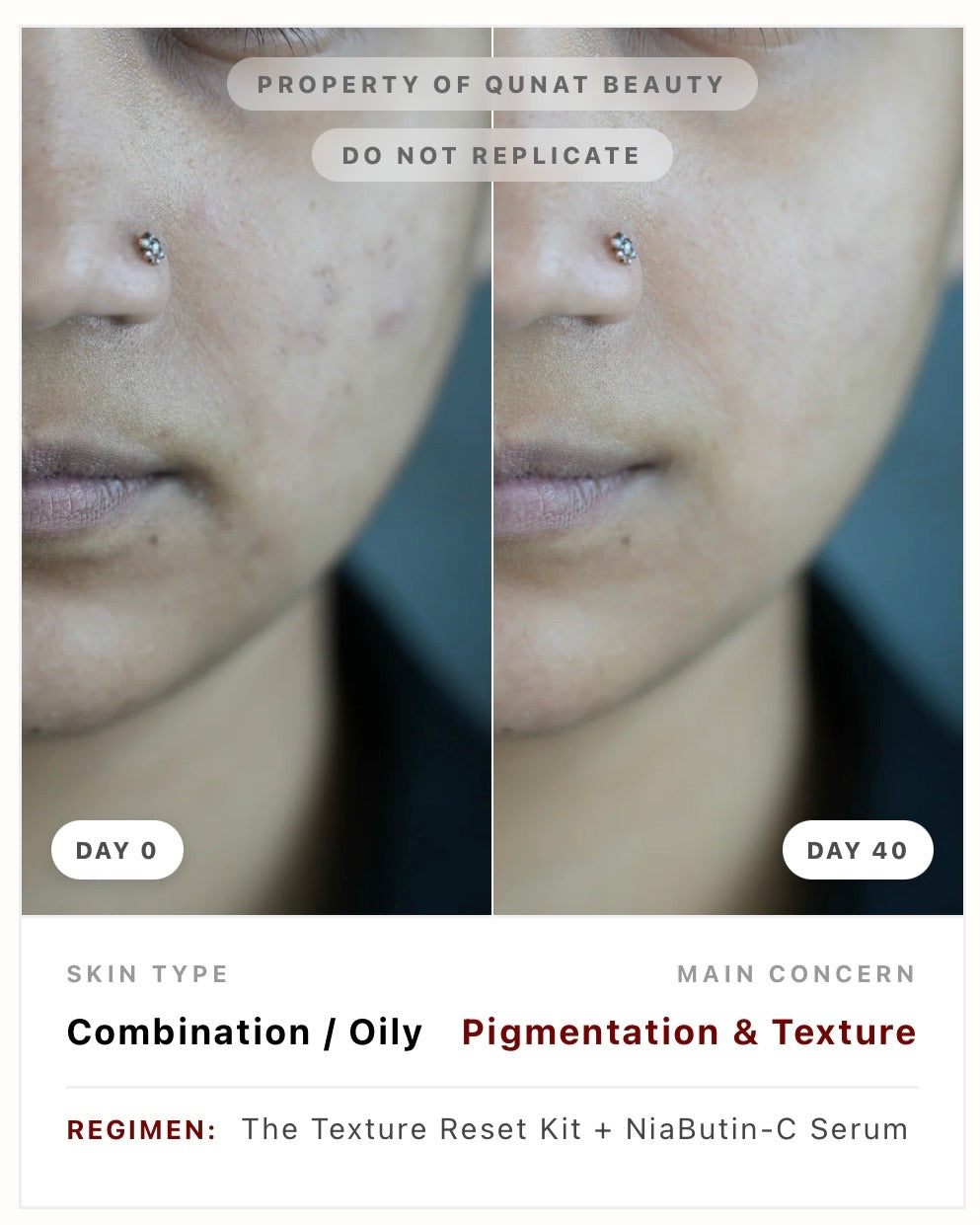
Expected Progression
Glycogommage begins the manual peeling process. By detaching dead surface cells, it instantly smooths tactile roughness and prepares the skin's architectural path.
As cell turnover accelerates, Glycogommage forces micro-comedones to the surface. This reset is essential for clearing long-term congestion within the pore walls.
Azelaik 12% stabilizes the surface. Redness and post-purge inflammation begin to fade as the active azelaic acid reinforces the skin barrier's integrity.
Full cellular turnover is complete. With Azelaik 12% regulating sebum and Glycogommage refining texture, pore appearance is minimized and light reflection is uniform.
The Products
The Texture Reset Essentials pairs two formulas that address skin congestion and hyperpigmentation through entirely different mechanisms. GlycoGommage dissolves and lifts. AzelaiK 12% penetrates and corrects.

GlycoGommage
Glycolic Acid (3%), Plant-Derived Cellulose (5%), Aloe Vera (3%). Dual-action peel that dissolves dead cell bonds and physically lifts debris. Used once weekly as your first step.

AzelaiK 12%
Azelaic Acid (12%, Micronized), Betaine (3%), Green Tea Extract (1%), Panthenol (1%). Deep follicular correction for PIH, PIE, and active acne. Applied as emulsion after serums.
Layering Guide
GlycoGommage is used once a week as your very first step, before cleansing, replacing MatchaMelt on that day. AzelaiK 12% is an emulsion applied after all serums. On all other days, start from Step 2.
Apply to dry skin before cleansing. Massage in circular motions for 60 seconds, then rinse. This replaces MatchaMelt on that day only.
First cleanse on all other days. Strongly recommended before your BHA cleanser to remove SPF, pollutants, and surface debris before the active cleanse begins.
Second cleanse daily. Salicylic Acid decongests the pore lining while Panthenol maintains barrier integrity throughout.
Toner step. Apply if using as part of a wider pigmentation protocol. Allow 60 seconds to absorb.
Serum step. Apply after toner if using as part of a wider brightening protocol.
Serum step. Apply before the emulsion layer to plump the barrier and lock serums in place.
Apply a pea-sized amount after all serums and press gently into the skin. The micro-emulsion base penetrates the follicular lining and seals the layers underneath simultaneously.
Final step. Ceramide NP and Squalane create an occlusive seal over all actives overnight.
Do not use GlycoGommage on the same day as other exfoliating actives. Always apply SPF the following morning.
Why These Two Ingredients Work Together
GlycoGommage and AzelaiK 12% are not two random products bundled together. They target two different but connected stages of the same problem — surface congestion and the pigmentation that congestion leaves behind. The clinical evidence for using them in sequence is substantial.
Glycolic Acid works at the surface, dissolving the bonds between dead skin cells to force cellular turnover and clear the blocked pores that cause congestion and post-inflammatory marks. Azelaic Acid works inside the follicle, inhibiting the tyrosinase enzyme that converts tyrosine into melanin — correcting the hyperpigmentation the congestion caused while simultaneously clearing the bacterial load driving new breakouts. One formula clears the path. The other corrects the damage.
The risk of using exfoliating actives on melanin-rich South Asian skin is post-inflammatory hyperpigmentation triggered by the exfoliation itself. Both formulas address this directly: GlycoGommage contains Aloe Vera and Panthenol to keep the barrier calm throughout the peel, and AzelaiK 12% has documented anti-inflammatory properties that reduce the inflammatory response that would otherwise cause rebound pigmentation. The combination produces stronger results than either ingredient alone without the rebound risk that makes standalone AHA treatments problematic for darker skin types.
GlycoGommage is used once a week to accelerate the shedding of pigmented surface cells. AzelaiK 12% is used nightly to prevent new pigment from forming in the follicle. The weekly exfoliation removes the evidence of past congestion. The nightly emulsion prevents new congestion and its pigmentary aftermath from forming. This is a complete correction and prevention protocol running in parallel, not in competition.
Duration of key combination study
Specifically studied in Fitzpatrick IV-VI
To hydroquinone 4% without the risks
Clinical Evidence — Why the Combination Works:
ADD TO THE REGIMEN
 TEXTURE RESET KIT
 NIABUTIN-C SERUM
Maximize your "Glass Skin" potential by combining these protocols. While the Texture Reset Essentials dissolve congestion and refine the dermal surface, NiaButin-C acts as a lipid-stabilizer, reducing redness, inhibiting melanin, and boosting the reflective "glow" of your newly surfaced skin cells.